The Biology of Adaptation
THE BIOLOGY OF ADAPTATION
Why the body only gets better after it is stressed, recovered, and repeated
INTRODUCTION: TRAINING IS NOT THE SAME AS ADAPTATION
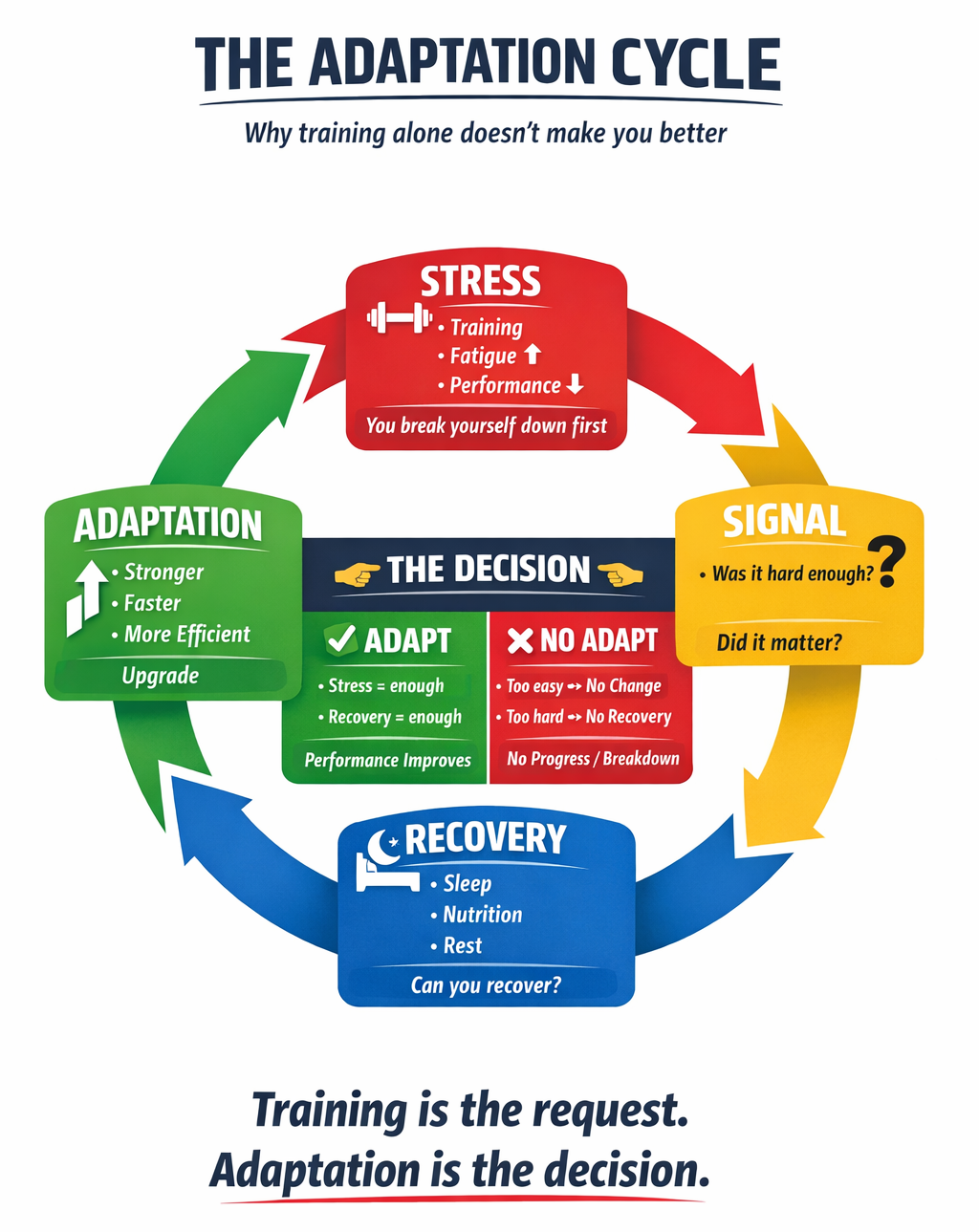
Most people think that if they train hard, they will automatically get better. They will get stronger, faster, leaner, or more “in shape” just because they put in the work. The reality is more complex. Training is the stress. Adaptation is the response. They are related, but they are not the same thing.
Every hard session, whether it is in the weight room, on the track, or during practice, creates controlled disruption. You walk away with more fatigue, more tissue damage, and temporarily worse performance than when you started. Only later, if the body “decides” the stress was worth responding to, do you see improvement. The real question is not “Did I train?” but “Did my body adapt to what I just did?”
To answer that, we have to look beneath the surface. The body does not adapt by accident. It uses specific biological systems and signaling pathways to detect stress, interpret it, and then decide whether to upgrade or just barely repair the damage. This article explains how that process works and why some training builds you up while other training just wears you down. (1–4)
Key point: Training is your request. Adaptation is your body’s decision about how to respond to that request.
THE BODY ONLY ADAPTS TO WHAT IT NOTICES
The first rule of adaptation is simple: the body only changes in response to what it can detect. If a stimulus is too small, it does not register as a threat or a challenge. If it is too large or arrives too often, it is interpreted as damage or danger rather than a useful training signal. (2,3)
When you train, you are asking your body a question: “Is what I can do today enough to handle this stress?” If the answer is “yes,” there is little reason to change. If the answer is “barely,” the body has a reason to adapt. If the answer is “absolutely not,” and you overwhelm your ability to recover, the response is more likely to be fatigue, burnout, or injury than improvement. (2,3)
In physiology, this is described in different ways: overload, threshold, and dose-response. At a practical level, the idea is straightforward. To adapt, the body needs:
- Enough stress to be different from daily life.
- Not so much stress that the recovery systems are overwhelmed.
- Enough repetition over time that the signal is consistent. (2,3)
Key point: The body is economical. It will not spend energy building capacity it does not need. Your training has to convince it that change is necessary.
DIFFERENT STRESSORS CREATE DIFFERENT ADAPTATIONS
Not all stress is the same. The type of stress you apply determines the type of adaptation you get. This is why a sprinter, a powerlifter, and a marathon runner can all train hard but end up with completely different abilities. (2,3)
MECHANICAL STRESS
Heavy strength training and explosive work create high mechanical tension and micro-damage in muscle fibers, tendons, and connective tissue. In response, the body reinforces the tissue—building more contractile proteins, strengthening connective tissue, and changing bone density over time. This is the basis of hypertrophy and strength gains. (2,3)
METABOLIC STRESS
Endurance work and repeated high-intensity intervals create sustained metabolic stress. Muscles deplete fuel stores, build up byproducts like hydrogen ions, and rely heavily on aerobic metabolism to keep going. In response, the body increases mitochondrial content, improves capillary networks, and becomes more efficient at using fats and carbohydrates for fuel. (2–4)
NEURAL STRESS
High-speed, high-power, or heavy-load training places a premium on the nervous system. The brain and spinal cord must learn to recruit the right motor units, fire them at the right time, and coordinate complex patterns under fatigue. Over time, the nervous system becomes more efficient. This is why athletes often get stronger or more skilled before they look any different. (2,3)
Key point: You do not get “general” fitness. You get better at exactly what you stress—mechanically, metabolically, and neurally.
mTOR VS. AMPK: TWO MAJOR ADAPTATION MODES
At the cellular level, two of the most important regulators of adaptation are mTOR and AMPK. You can think of them as two different “modes” the body can prioritize: building and growth (mTOR) or energy management and efficiency (AMPK). (1–4)
MTOR: BUILD AND GROW
mTOR (mechanistic target of rapamycin) is a key pathway that promotes protein synthesis, cell growth, and hypertrophy. When there is plenty of energy and amino acids—such as after a meal and a strength session—mTOR activity increases. This leads to:
- Increased muscle protein synthesis.
- Growth of muscle fibers.
- Remodeling of tissues to handle higher loads. (1,2,4)
AMPK: CONSERVE AND IMPROVE EFFICIENCY
AMPK (AMP-activated protein kinase) is an energy sensor. When the cell senses low energy availability—like during prolonged endurance exercise, fasting, or repeated high-intensity work—AMPK activates. This leads to:
- Increased glucose uptake and fat oxidation.
- Signals to grow more mitochondria.
- A relative decrease in energy-expensive processes like protein synthesis. (1–4)
The key is not that one is “good” and the other is “bad.” Both are necessary. Strength and power training tilt the balance more toward mTOR, supporting growth and force production. Endurance and energy stress tilt it more toward AMPK, supporting efficiency and fatigue resistance. How you train—and how you fuel and recover afterward—determines which mode dominates. (1–4)
Key point: Adaptation is not random. It is governed by switches like mTOR and AMPK that shift the body toward building muscle or improving endurance, depending on the signals you send.
MITOCHONDRIA ADAPT TO DEMAND
In a previous article, mitochondria were described as the powerhouses of the cell because they produce most of the ATP that powers cellular function. For adaptation, the important idea is that mitochondria are not fixed. They respond to how you live and train. (3,4)
When you regularly challenge your aerobic system—through steady-state cardio, intervals, or repeated bouts of submaximal work—your muscles experience periods of energy stress. This activates pathways such as AMPK and PGC-1α (a major transcriptional coactivator), which together signal the cell to:
- Build more mitochondria (mitochondrial biogenesis).
- Improve the efficiency of existing mitochondria.
- Enhance the ability to use both fats and carbohydrates for fuel. (3,4)
The result is that you can produce more ATP with less relative stress. You feel less fatigued at a given pace, recover faster between efforts, and can tolerate more total work. This is not just an “endurance athlete” benefit; it matters for any sport that requires repeated efforts, from basketball to soccer to conditioning-heavy strength programs. (3,4)
Key point: Mitochondria adapt exactly to the demands you impose. If you never ask them to work hard, they won’t. If you challenge them wisely, they multiply and become more efficient.
THE NERVOUS SYSTEM ADAPTS BEFORE THE MUSCLES DO
One of the most common experiences in training is getting stronger before you look any different. Early in a strength program, athletes often see rapid increases in the weight they can lift without major changes in muscle size. This is not magic—it is neural adaptation. (2,3)
The nervous system improves in several ways:
- Better motor unit recruitment: The brain learns to activate more muscle fibers at the same time.
- Better rate coding: Motor units fire more rapidly, producing more force.
- Better coordination: Agonist and antagonist muscles time their contractions more efficiently.
- Better motor patterns: The brain refines technique, making movements smoother and more economical. (2,3)
These changes are why consistent practice—even with submaximal loads—can dramatically improve performance. It is also why time away from training often feels “rusty” before it looks different: the nervous system loses some of its efficiency even if muscle mass has not changed much yet.
Key point: Early gains are often neural, not structural. The brain and nervous system adapt quickly, laying the groundwork for longer-term muscular adaptation.
THE IMMUNE SYSTEM HELPS REMODEL TISSUE
Adaptation is not only about signaling and energy—it is also about construction. When you impose mechanical and metabolic stress, you create micro-damage in tissues. The immune system is responsible for cleaning up and coordinating the rebuild. (2,3)
After hard training, immune cells move into the stressed area and initiate a controlled inflammatory response. While inflammation often gets a bad reputation, here it serves important roles:
- Removing damaged proteins and cellular debris.
- Releasing cytokines and growth factors that activate satellite cells and other repair mechanisms.
- Creating the environment for new tissue to form. (2,3)
Over time, with appropriate recovery, this cycle leads to stronger, more resilient tissue. When recovery is inadequate, or when other stressors (poor sleep, poor nutrition, chronic life stress) are stacked on top of training, the immune system can remain in a low-grade, chronic inflammatory state. This is associated with slower repair, more frequent illness, and reduced capacity to adapt. (2,3)
Key point: The immune system is not just for fighting infections. It is a critical partner in rebuilding and remodeling tissue after training.
SLEEP: WHERE ADAPTATION GETS LOCKED IN
Recovery and adaptation are not just about what happens while you are awake. Many of the most important processes for long-term adaptation occur during sleep. Without sufficient quality sleep, the body struggles to convert training stress into useful change. (2,3)
DURING DEEP SLEEP, THE BODY
- Releases growth hormone in pulses, supporting protein synthesis and tissue repair.
- Resets cortisol patterns, helping restore normal day–night rhythm and stress balance.
- Allows the immune system to coordinate inflammatory and anti-inflammatory responses.
- Provides a low-stress environment for mitochondria to repair oxidative damage and restore function. (2,3)
On the neural side, sleep also supports memory consolidation including motor learning. This is where your brain refines and stabilizes new movement patterns, making them more automatic the next time you train. (2,3)
If training is the “input,” sleep is where much of the “processing” and “saving” happens. Chronic sleep loss does not just make you tired; it directly interferes with hormone balance, immune function, mitochondrial performance, and neural adaptation.
Key point: Adaptation is not complete until your body has had a chance to process the stress. Sleep is when that processing is most active.
WHEN ADAPTATION BECOMES MALADAPTATION
All of the systems described—neuroendocrine, immune, mitochondrial, neural—are designed to help you adapt. But they can only do that when the balance between stress and recovery is appropriate. When training load is too high for too long, or recovery is chronically inadequate, the same systems that should make you better can start to make you worse. (2,3)
Signs that the stress–recovery cycle is breaking down include:
- Persistent fatigue that does not resolve with normal rest.
- Performance that stalls or declines despite continued effort.
- Soreness, joint pain, or nagging issues that never fully clear.
- Poor sleep and difficulty relaxing.
- More frequent illnesses or taking longer to recover from minor colds. (2,3)
In this state, the body is not adapting up—it is adapting to survive. Hormones are shifted toward managing chronic stress, inflammation is more likely to be systemic than localized, and mitochondrial and neural efficiency can decline. This is the biology of maladaptation, sometimes labeled overreaching or overtraining when severe and prolonged.
Key point: Adaptation is not guaranteed. If the stress exceeds your recovery for long enough, the direction of change reverses.
CONCLUSION: TRAINING IS THE REQUEST, ADAPTATION IS THE UPGRADE
When you train, you are placing an imposed demand on the body. If the imposed demand is enough both in volume and frequence but not too much, and with proper rest and recovery, then the body responds by adapting.
- The body only adapts to stress it can detect.
- Different stressors produce different adaptations.
- Cellular switches like mTOR and AMPK push the body toward growth or efficiency.
- Mitochondria, the nervous system, and the immune system remodel themselves to match the demands you place on them.
- Sleep and recovery are where these changes are consolidated.
You do not get better from training alone. You get better from the way your body interprets and responds to training over time. Training is the signal. Adaptation is the upgrade. Your job is to manage the stress and recovery so those upgrades keep coming.
It’s Not Rocket Science