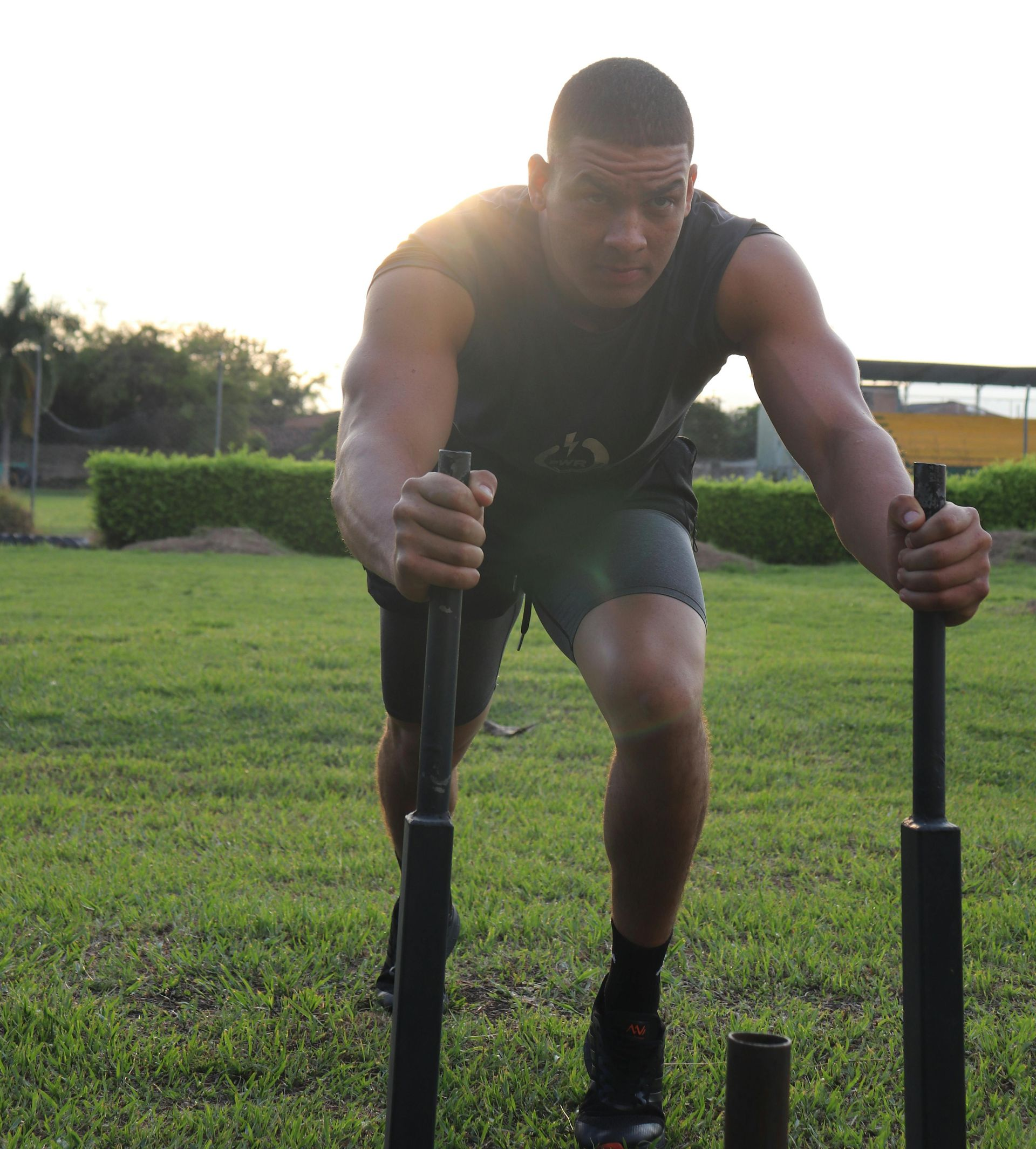
Introduction: Not All Muscle Is Built the Same
Most people treat muscle like a uniform substance. You work it, it grows, it gets stronger. But that is not how it works. Your muscles are made up of different types of fibers — and each fiber type responds differently to training, fatigue, and recovery. Training without understanding this is like trying to mix concrete without knowing the ratio of cement to water. You might get something, but it will not be optimal.
Muscle fiber types are not a niche topic for elite athletes. They are the biological explanation for why two people can follow the exact same program and get completely different results. They explain why a natural sprinter struggles to build aerobic endurance, why a distance runner has a hard time generating explosive power, and why most athletes fall somewhere on a spectrum between those extremes.
Understanding your fiber type profile — and training to match it — is one of the most underutilized tools in program design. Your fiber types are the blueprint. Your training should be the construction plan built around them.
Quick Reference: Fiber Types at a Glance
| Property | Type I (Slow-Twitch) | Type IIa (Fast-Twitch) | Type IIx (Fast-Twitch) |
|---|---|---|---|
| Speed of Contraction | Slow | Fast | Very Fast |
| Force Output | Low | Moderate–High | Very High |
| Fatigue Resistance | Very High | Moderate | Low |
| Primary Energy System | Aerobic (oxidative) | Aerobic + Glycolytic | Glycolytic + ATP-PC |
| Mitochondrial Density | High | Moderate | Low |
| Myosin Heavy Chain Isoform | MHC-I | MHC-IIa | MHC-IIx |
| Capillary Density | High | Moderate | Low |
| Glycogen Storage | Low | Moderate | High |
| Best Suited For | Endurance, posture, long-duration effort | Hybrid efforts — strength and endurance | Power, sprinting, max force |
| Trainability (Conversion) | Stable — difficult to shift | Highly adaptable | Can shift toward IIa with training |
What Muscle Fibers Actually Are
Skeletal muscle is not one tissue — it is a collection of individual cells called muscle fibers, bundled together in groups called fascicles. Each fiber runs the full length of a muscle and is controlled by a motor neuron. A single motor neuron and all the fibers it controls is called a motor unit. When the nervous system fires a signal, all the fibers in that motor unit contract together — an all-or-nothing event known as the all-or-none principle (1).
The type of fiber in a motor unit is determined primarily by the type of motor neuron innervating it. Slow motor neurons control Type I fibers. Fast motor neurons control Type II fibers. This is why the nervous system and the muscular system cannot be separated when we talk about training — the neural signal comes first, and the fiber responds (1)(2).
Fiber type is largely established by genetics. Studies of identical twins show that roughly 45 to 55 percent of fiber type composition is heritable, meaning you are born with a significant predisposition (3). But training can shift certain fiber types within the fast-twitch family, and it can dramatically change how well each fiber type performs — even if it cannot fundamentally reclassify a slow fiber as a fast one (3)(4).
The Size Principle: How Your Body Recruits Fibers
The body does not activate all fiber types simultaneously. It follows a strict recruitment order called Henneman's Size Principle, established in 1965 and still considered the foundational model of motor unit recruitment (5).
The principle is straightforward: the nervous system recruits the smallest, most fatigue-resistant motor units first, and only activates larger, more powerful motor units as demand increases. This means:
- At low intensity — walking, easy cycling, light loads — Type I fibers do nearly all the work
- As intensity rises — moderate lifting, tempo pace — Type IIa fibers are progressively recruited
- At maximum intensity — sprinting, heavy maximal lifts, explosive jumps — Type IIx fibers are finally called in
The practical implication of this is enormous: if you never train at high enough intensity, you never sufficiently challenge your Type II fibers. You can do thousands of reps at moderate loads and those fast-twitch fibers will barely be touched.
The Fiber Type Spectrum: Where Athletes Land
Human muscles are never purely one fiber type. Every muscle contains a mixture of Type I and Type II fibers, and the ratio differs by muscle group and by individual. The soleus (deep calf) is predominantly Type I in most people — it stabilizes posture all day. The gastrocnemius (outer calf) has a higher Type II proportion. The biceps brachii tends toward more Type II than the postural muscles of the spine (6).
Research on elite athletes reveals that fiber type distribution is a significant performance variable at the extremes. Elite marathoners often show 70 to 80 percent Type I fibers in the vastus lateralis (quadriceps). Elite sprinters show the inverse — 70 to 80 percent Type II(3)(7). Most recreational and competitive athletes fall somewhere in the middle, and that middle ground is where training has its greatest effect.
Can You Change Your Fiber Type?
This is where the science gets nuanced — and where a lot of popular fitness advice gets it wrong. The short answer is: you cannot fundamentally convert Type I to Type II, but you have significant control over how each fiber performs, and the IIx-to-IIa shift is both real and trainable.
Genetics set the broad boundaries. A person born with 70 percent Type I fibers is not going to train their way into a 70 percent Type II profile. The myosin heavy chain isoforms that define fiber type identity are deeply regulated at the genetic level, and no amount of training in healthy adults has been shown to produce meaningful Type I-to-Type II or Type II-to-Type I conversion (3)(4).
Within the fast-twitch category, Type IIx fibers can shift toward the IIa phenotype with sustained endurance or resistance training — and this is actually a significant performance benefit. Type IIa fibers are faster to recover, more oxidative, and better suited to repeated high-intensity efforts than Type IIx (4)(8).
Conversely, detraining — even a few weeks of significant inactivity — causes Type IIa fibers to drift back toward the IIx profile. This is one of the arguments for training consistency over intensity peaks. You are not just building capacity; you are maintaining a favorable fiber type expression (4)(8).
Beyond isoform shifts, training can dramatically alter the functional profile of every fiber type:
- Endurance training increases mitochondrial density in Type II fibers — making them more aerobically capable without changing their identity
- Resistance training increases the cross-sectional area (size) of both Type I and Type II fibers, increasing force production
- Sprint and power training increases rate of force development and neural drive, improving the effectiveness of fast-twitch recruitment
Training Application: How to Target Each Fiber Type
The Size Principle tells us that different training stimuli recruit different fiber type populations. Smart programming does not just pick one — it deliberately trains across the full spectrum, with the mix weighted toward the athlete's goal and fiber type profile.
- Zone 2 aerobic work: 60–75% max HR for 30–90 min
- High-rep / low-load resistance: 15–30 reps, 30–60 sec rest
- Tempo training at lactate threshold
- Muscular endurance circuits with incomplete rest
These fibers respond to volume and duration. Consistency across weeks and months is the primary driver.
- Anaerobic intervals: 85–95% effort, 1:2 to 1:3 work-to-rest
- Hypertrophy-range lifting: 6–12 reps, 60–90 sec rest
- Threshold repeats with moderate recovery
- Sport-specific conditioning at race/game pace
Type IIa is the most trainable fiber. It adapts in both aerobic and anaerobic directions depending on stimulus.
- Maximal sprints: 95–100% effort, full rest (1:8 to 1:10)
- Max-strength lifting: 90–100% 1RM, 3–5 min rest
- Plyometrics: box jumps, broad jumps, depth drops
- Olympic lifts: power clean, hang snatch at high velocity
Type IIx fibers require near-maximal or maximal intensity to be recruited. Anything less and you are training the wrong fibers for this goal. Full recovery between sets is non-negotiable — fatigue shifts recruitment back to Type I and IIa.
45 min Zone 2 run at conversational pace. HR stays 130–145. No rest breaks. This session contributes zero Type IIx recruitment but builds significant mitochondrial density and capillary supply in Type I fibers.
8 × 40m sprints at 100% effort. Full rest: 4–5 min between efforts. Session is over in 35 minutes but every effort reaches maximum neural and mechanical output. This session produces zero aerobic development.
4 sets × 8 reps back squat at 75% 1RM. 90 sec rest. Moderate load with controlled rest produces mechanical tension and metabolic stress — the primary drivers of Type IIa growth and adaptation.
6 × 400m at 90% effort with 2 min rest, followed by 4 × 60m sprints at 100% with full recovery. Recruits Type I and IIa through the intervals, then hits Type IIx in the sprints after partial pre-fatigue.
Fiber Types and the Hybrid Athlete
The hybrid athlete framework — training for both strength and endurance simultaneously — is built on one core physiological challenge: the interference effect. When high volumes of endurance work are combined with maximal strength and power training, the signaling pathways for each adaptation compete (9).
Endurance training activates AMPK (AMP-activated protein kinase), which signals aerobic adaptation but can suppress the mTOR pathway that drives muscle protein synthesis and strength gains. Heavy resistance training activates mTOR and suppresses AMPK. When both stimuli are applied simultaneously without careful programming, each partially blunts the other (9)(10).
Understanding fiber types gives you the tool to manage this. The hybrid athlete's goal is to develop aerobic capacity in Type I and IIa fibers while preserving explosive capacity in Type IIx fibers — and that requires deliberate separation of training stimuli, not random mixing of modalities.
| Hybrid Programming Principle | Fiber Type Logic | How to Apply It |
|---|---|---|
| Separate power and endurance sessions | Prevents AMPK-mTOR interference | Sprint/strength in AM, aerobic in PM or separate day |
| Never sprint after long aerobic work | Fatigued Type IIx fibers cannot express maximal output | Flip session order: power before aerobic |
| Prioritize Zone 2 for aerobic base | Builds mitochondria without fatiguing fast-twitch fibers | Keep easy runs truly easy — below lactate threshold |
| Use high intensity sparingly | IIx fibers require full recovery to adapt | 1–2 maximal sessions per week; not every workout |
| Deload protects IIa expression | IIa drifts back to IIx during detraining | Planned low-intensity weeks maintain fiber type profile |
How Do You Know Your Fiber Type Profile?
The gold standard for identifying fiber type composition is a muscle biopsy — a needle extraction of a small tissue sample that is then stained and analyzed under a microscope for myosin heavy chain isoforms. This is used in elite sport science but is not practical for most athletes (3).
For practical purposes, several field-based indicators can help estimate your fiber type tendencies:
| Indicator | Type I Dominant | Type II Dominant |
|---|---|---|
| Rep Max Test at 80% 1RM | Can complete 10+ reps | Reaches failure closer to 4–6 reps |
| Sport History | Naturally gravitates toward distance sports | Naturally excels at power/sprint sports |
| Recovery Rate | Recovers quickly between sets | Needs longer rest but produces more peak force |
| Fatigue Pattern | Slow fade over time; rarely "hits a wall" | Strong initially; drops off sharply with fatigue |
| VO₂max Profile | High aerobic capacity relative to body size | Lower VO₂max but higher anaerobic power output |
These are tendencies, not definitive measures. But combined, they paint a usable picture of your fiber type profile — and that picture should inform how you structure the emphasis of your training across a program cycle.
Conclusion: Train the Blueprint, Not the Template
Generic training programs are built for an average athlete — which means they are optimally designed for almost no one. Fiber type is one of the foundational reasons why the same program produces such different results in different people. It is not motivation. It is not effort. It is biology.
Understanding your fiber type profile does not mean accepting limits. It means understanding your starting point. A Type I-dominant athlete who never does maximal intensity work is leaving speed and power on the table. A Type II-dominant athlete who never accumulates aerobic volume is leaving endurance and recovery capacity on the table. Both are training with an incomplete blueprint.
The goal is not to train harder. It is to train with enough understanding of your own physiology that every session is moving you in a deliberate direction — recruiting the right fibers, at the right intensity, with the right recovery, for the right adaptation.